Kurš apprecējās ar Cleopatra VII?
Ptolemy XIII Theos Philopator precējies Cleopatra VII .
Laulība beidzās .
Ptolemy XIV of Egypt precējies Cleopatra VII .
Laulība beidzās .
Mark Antony precējies Cleopatra VII .
Laulība beidzās . Iemesls: subjekta nāve
Cleopatra VII: Laulības statusa laika skala
1 Pixel = 1 Month

Cleopatra VII
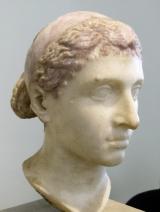
Cleopatra VII Thea Philopator (Koine Greek: Κλεοπάτρα Θεά Φιλοπάτωρ, lit. 'Cleopatra father-loving goddess'; 70/69 BC – 10 or 12 August 30 BC) was Queen of the Ptolemaic Kingdom of Egypt from 51 to 30 BC, and the last active Hellenistic pharaoh. A member of the Ptolemaic dynasty, she was a descendant of its founder Ptolemy I Soter, a Macedonian Greek general and companion of Alexander the Great. Her first language was Koine Greek, and she is the only Ptolemaic ruler known to have learned the Egyptian language, among several others. After her death, Egypt became a province of the Roman Empire, marking the end of the Hellenistic period in the Mediterranean, which had begun during the reign of Alexander (336–323 BC).
Born in Alexandria, Cleopatra was the daughter of Ptolemy XII Auletes, who named her his heir before his death in 51 BC. Cleopatra began her reign alongside her brother Ptolemy XIII, but a falling-out between them led to a civil war. Roman statesman Pompey fled to Egypt after losing the 48 BC Battle of Pharsalus against his rival Julius Caesar, the Roman dictator, in Caesar's civil war. Pompey had been a political ally of Ptolemy XII, but Ptolemy XIII had him ambushed and killed before Caesar arrived and occupied Alexandria. Caesar then attempted to reconcile the rival Ptolemaic siblings, but Ptolemy XIII's forces besieged Cleopatra and Caesar at the palace. Shortly after the siege was lifted by reinforcements, Ptolemy XIII died in the Battle of the Nile. Caesar declared Cleopatra and her brother Ptolemy XIV joint rulers, and maintained a private affair with Cleopatra which produced a son, Caesarion. Cleopatra traveled to Rome as a client queen in 46 and 44 BC, where she stayed at Caesar's villa. After Caesar's assassination, followed shortly afterwards by the sudden death of Ptolemy XIV (possibly murdered on Cleopatra's order), she named Caesarion co-ruler as Ptolemy XV.
In the Liberators' civil war of 43–42 BC, Cleopatra sided with the Roman Second Triumvirate formed by Caesar's heir Octavian, Mark Antony, and Marcus Aemilius Lepidus. After their meeting at Tarsos in 41 BC, the queen had an affair with Antony, which produced three children. Antony became increasingly reliant on Cleopatra for both funding and military aid during his invasions of the Parthian Empire and the Kingdom of Armenia. The Donations of Alexandria declared their children rulers over various territories under Antony's authority. Octavian portrayed this event as an act of treason, forced Antony's allies in the Roman Senate to flee Rome in 32 BC, and declared war on Cleopatra. After defeating Antony and Cleopatra's naval fleet at the 31 BC Battle of Actium, Octavian's forces invaded Egypt in 30 BC and defeated Antony, who committed suicide. After his death, Cleopatra reportedly killed herself, probably by poisoning, to avoid being publicly displayed by Octavian in a Roman triumphal procession.
Cleopatra's legacy survives in ancient and modern works of art. Roman historiography and Latin poetry produced a generally critical view of the queen that pervaded later Medieval and Renaissance literature. In the visual arts, her ancient depictions include Roman busts, paintings, sculptures, cameo carvings and glass, Ptolemaic and Roman coinage, and reliefs. In Renaissance and Baroque art, she was the subject of many works including operas, paintings, poetry, sculptures, and theatrical dramas. She has become a pop culture icon of Egyptomania since the Victorian era, and in modern times has appeared in the applied and fine arts, burlesque satire, Hollywood films, and brand images for commercial products.
Lasīt vairāk...
Ptolemy XIII Theos Philopator

Ptolemy XIII Theos Philopator (Ancient Greek: Πτολεμαῖος Θεός Φιλοπάτωρ, Ptolemaĩos; c. 62 BC – 13 January 47 BC) was Pharaoh of Egypt from 51 to 47 BC, and one of the last members of the Ptolemaic dynasty (305–30 BC). He was the son of Ptolemy XII and the brother of and co-ruler with Cleopatra VII. Cleopatra's exit from Egypt caused a civil war to break out between the pharaohs. Ptolemy later ruled jointly with his other sister, Arsinoe IV.
Lasīt vairāk...Cleopatra VII
Ptolemy XIV of Egypt

Ptolemy XIV Philopator (Ancient Greek: Πτολεμαῖος Φιλοπάτωρ, Ptolemaios; c. 59 – 44 BC) was nominally pharaoh of Ptolemaic Egypt, reigning with his sister-wife Cleopatra from 47 BC until his death in 44 BC.
Lasīt vairāk...Cleopatra VII
Mark Antony
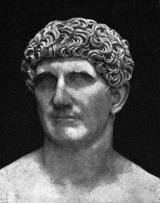
Marks Antonijs (latīņu: Marcus Antonius Marci Filius Marci Nepos; dzimis 83. gada 14. janvārī p.m.ē., miris 30. gada 1. augustā p.m.ē.) bija romiešu politiķis un ģenerālis.
Lasīt vairāk...